
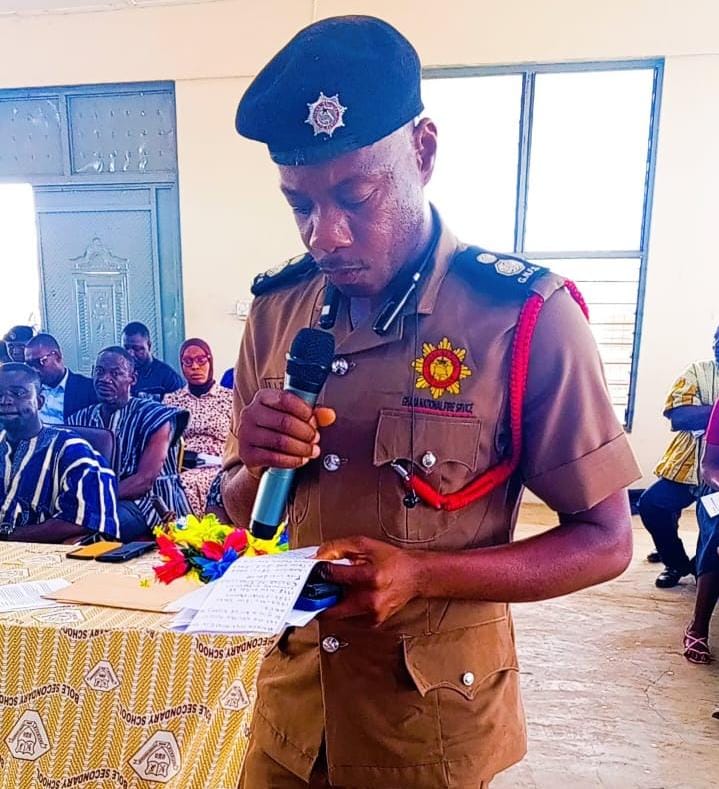
The Bole Sector of the Ghana National Fire Service (GNFS) has expressed concern over the recent spate of fire outbreaks in senior high schools, describing the trend and timing as alarming.
Station Officer II, Ibrahim Alhassan Bawa, speaking during the launch of Anti-Drug and Environmental Campaign by the Savannah Region Council of State Member at the Bole Senior High School on February 11, 2026 disclosed that three separate fire incidents were recorded within a short period.
According to him, one incident occurred at Nobisco on January 28, 2026, while two others were recorded on February 2, 2026, at Tolon Senior High School and Pong Tamale.
“Looking at the whole situation and the timing of these incidents, it is very alarming,” he stated.
Mr. Bawa attributed the fires to a number of possible factors, particularly unsafe electrical practices and certain activities of students within school premises.
He explained that one major cause is the deterioration of electrical wiring systems in many secondary schools. According to him, several institutions have not replaced or maintained their wiring systems for years, leading to broken insulation and exposed cables, which can easily spark fires.
Another key concern raised was the unauthorized use of electrical gadgets, especially mobile phones, in dormitories. Mr. Bawa noted that many students secretly charge their phones while attending classes or prep sessions, often hiding the devices under mattresses or among combustible materials to avoid detection.
“Most of these fires occur when students are not in their dormitories. They leave electrical appliances charging and hide them under mattresses. This can easily trigger a fire,” he warned.
He further highlighted poor storage practices in dormitories, where combustible materials such as clothing and books are placed close to damaged electrical fittings. He explained that power fluctuations, common in many areas can cause cables to overheat. When overheated wires come into contact with flammable materials, they can ignite fires.
Mr. Bawa also cautioned against the overloading of extension boards in dormitories. He observed that in some cases, a single extension board is used by multiple students to charge various devices simultaneously, especially before classes or prep. Many of these extension boards, he said, are of low quality and not designed to handle heavy loads.
“In the event of power fluctuation, overloaded extension boards can easily spark and start a fire,” he added.
The Station Officer called on school authorities and students to take fire safety measures seriously, including regular maintenance of electrical systems, proper supervision in dormitories, and strict adherence to safety guidelines regarding the use of electrical appliances.
He assured the public that the Ghana National Fire Service remains ready to provide fire safety education to schools and other organized groups.
“We are always ready to engage with any organized body to provide fire safety education,” Mr. Bawa emphasized.
He urged stakeholders in the education sector to prioritize fire prevention strategies to safeguard lives and property in schools
source: nkilgifm.com
