
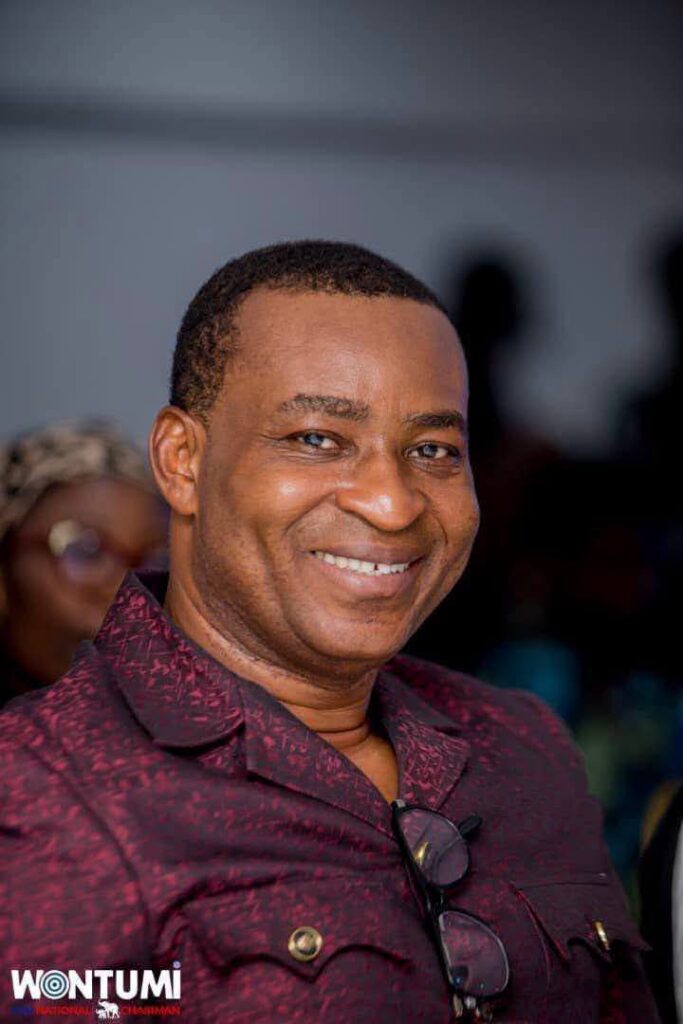
A Presiding Judge in the confines of his/her judicial seat, sees one thing, applies one thing and delivers one thing—the law, the law and the law.
The Minerals and Mining Act, 2006 (Act 703) has evolved since its enactment 2 decades ago. Through its amendments in 2011, 2015 and 2019, the state collectively revised its biting strength. From a less punitive code to a convincingly harsher law that prescribes punishment to its offenders with the same energy with which they destroy and poison our water bodies.
Coincidentally, the specific amendment that had its claws on the powerful wings of one of the most powerful personalities in Ghana in the last decade was effected by the very legal hands of his own government. Indeed, the 2019 amendment to the parent Act, 703, by the substitution of section 99 in place of 81 of the parent Act saw an increase in the penalties for offenders.
The inserted section {99(2)(b) and (c)} specifically spelt out that which has become the bait for Chairman Wountimi. Indeed, by 99(2)(b), he was found culpable of facilitating and aiding the commission of an act of illegal mining contrary to the Act. Thereupon, 99(2)(c) sets out the punishment therein—a minimum sentence of 15 years imprisonment or a fine, a maximum of 25 years or a fine, OR both the custodial sentence and the fine. A just Justice who reads the mood of the country and sail along what a reasonable people will prefer, weaved along the middle line with a 59 page legal reasoning, applicable laws and stating vividly the facts, handed our powerful Chairman, a 20 year jail term with hard labour.

Why do I feel that the noise that greeted the arrest of Miracles Aboagye was heavier than this conviction? Well, where justice is seen to be served, a people rejoice even in silence.
Now my verdict!!
There are moments in the life of a nation when the outcry of party must yield to the stiller voice of justice. Monday, 20 July 2026, may prove to be one such moment. Bernard Antwi-Boasiako, widely known as Chairman Wontumi, was sentenced to 20 years imprisonment with hard labour. while Akonta Mining Limited was fined for offences under Ghana’s Mineral and Mining (Amendment) Act, 2019.
Before the ink upon the judgment had scarcely dried, many proclaimed persecution. Yet a sober people must ask a more solemn question: should a verdict be weighed by the colour of the accused’s political banner, or by the weight of the evidence that bore him to conviction?
The court did not try a party chairman. It tried a “responsible citizen.” The core facts were neither hidden nor fiercely contested. It was admitted that Henry Okum operated on Akonta Mining’s concession without the written approval required by law, contrary to section 99(2) (a) of the Act.
The dispute lay not in the deed, but in its intention. Was the land entrusted merely for reclamation, or was it opened for unlawful mining?
Like a careful gardener separating wheat from tares, the court examined admissions, documents, and conduct. It found the defence wanting, not because of the man’s politics, but because the evidence pointed elsewhere, and the act indeed came in fierce contact with the law.
The Constitution itself was summoned to Wontumi’s aid. Why invoke Article 130 of the 1992 Constitution for constitutional interpretation when nothing was particular was up for clarity? Well, the court did not cast this plea aside in haste. It measured it carefully and found the statute plain enough to guide both citizen and judge. If the law spoke with sufficient clarity, then the refuge sought in ambiguity became but a house built upon sand.
Equally significant was the court’s refusal to let the corporate veil become a curtain behind which responsibility might hide. A company cannot become a cloak beneath which a single directing mind escapes accountability. You see strict application of the reasonable ruling of the court in the almighty 1897 case of Salomon V Salomon. So we are left to ask, what becomes of justice if wealth may wear the mask of incorporation while conscience slips quietly through the back door?
The sentence itself has stirred the deepest passions. Twenty years is no light burden. Yet Parliament, mindful of the wounds inflicted by galamsey upon rivers once clear as crystal and fields once rich with promise, ordained a punishment ranging 15 to 25 years.
The court chose neither the harshest rod nor the gentlest whisper. It walked the middle path prescribed by the law.
Still, every just society must preserve room for honest doubt. Questions about selective prosecution, political timing, and judicial independence deserve careful examination, and the Appellate Courts exist for that very purpose. Justice is strengthened, not weakened, when judgments are tested.
But until a higher court speaks, another question lingers over the conscience of the Republic, like the evening bell over an old cathedral—if the law bends whenever it stands before the powerful, does it remain a law, or does it become merely an ornament for the weak?
A nation is not preserved by the triumph of factions, but by the steadfastness of its institutions. The river does not ask whether the hand that poisons it wears red, blue, or green. It carries the poison all the same. So too must justice remain blind to party, lest tomorrow’s powerful inherit a kingdom where influence outweighs innocence and office stands above the law.
“The law is still the law.”
By Issifu Seidu Kudus Gbeadese ESQ
(Youth Imam from Laribanga)
0244198031
saeedqudus@gmail.com
